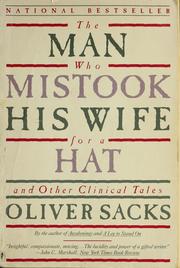
In his most extraordinary book, “one of the great clinical writers of the twentieth century” *(The New York Times)* recounts the case histories of patients lost in the bizarre, apparently inescapable world of neurological disorders. Oliver Sacks’s *The Man Who Mistook His Wife for a Hat* tells the stories of individuals afflicted with fantastic perceptual and intellectual aberrations: patients who have lost their memories and with them the greater part of their pasts; who are no longer able to recognize people and common objects; who are stricken with violent tics and grimaces or who shout involuntary obscenities; whose limbs have become alien; who have been dismissed as retarded yet are gifted with uncanny artistic or mathematical talents. If inconceivably strange, these brilliant tales remain, in Dr. Sacks’s splendid and sympathetic telling, deeply human. They are studies of life struggling against incredible adversity, and they enable us to enter the world of the neurologically impaired, to imagine with our hearts what it must be to live and feel as they do. A great healer, Sacks never loses sight of medicine’s ultimate responsibility: “the suffering, afflicted, fighting human subject.”
Enjoyed their writing? Take home one of their books.
★ 3.7 · 37 ratings on Open LibrarySociology2011592 pages
"In his Pulitzer Prize-winning bestseller Guns, Germs, and Steel, Jared Diamond examined how and why Western civilizations developed the technologies and immunities that allowed them to dominate much of the world. Now, Diamond probes the other side of the equation: What caused some of the great civilizations of the past to collapse into ruin, and what can we learn from their fates?" "As in Guns, Germs, and Steel, Diamond weaves an all-encompassing global thesis through a series of historical-cultural narratives. Moving from the prehistoric Polynesian culture on Easter Island to the formerly flourishing Native American civilizations of the Anasazi and the Maya, the doomed medieval Viking colony on Greenland, and finally to the modern world, Diamond traces a fundamental pattern of catastrophe, spelling out what happens when we squander our resources, when we ignore the signals our environment gives us, and when we reproduce too fast or cut down too many trees. Environmental damage, climate change, rapid population growth, unstable trade partners, and pressure from enemies were all factors in the demise of the doomed societies, but other societies found solutions to those same problems and persisted."--BOOK JACKET
★ 4.1 · 154 ratings on Open LibraryPrize:Pulitzer=19982017528 pages
An epic detective story that offers a gripping expose on why the world is so unequal. Professor Jared Diamond traveled the globe for over 30 years trying to answer this question.
★ 3.7 · 37 ratings on Open LibrarySociology2011592 pages
"In his Pulitzer Prize-winning bestseller Guns, Germs, and Steel, Jared Diamond examined how and why Western civilizations developed the technologies and immunities that allowed them to dominate much of the world. Now, Diamond probes the other side of the equation: What caused some of the great civilizations of the past to collapse into ruin, and what can we learn from their fates?" "As in Guns, Germs, and Steel, Diamond weaves an all-encompassing global thesis through a series of historical-cultural narratives. Moving from the prehistoric Polynesian culture on Easter Island to the formerly flourishing Native American civilizations of the Anasazi and the Maya, the doomed medieval Viking colony on Greenland, and finally to the modern world, Diamond traces a fundamental pattern of catastrophe, spelling out what happens when we squander our resources, when we ignore the signals our environment gives us, and when we reproduce too fast or cut down too many trees. Environmental damage, climate change, rapid population growth, unstable trade partners, and pressure from enemies were all factors in the demise of the doomed societies, but other societies found solutions to those same problems and persisted."--BOOK JACKET